Managing masonry tear-outs and foundation pours requires strict containment protocols to prevent structural driveway failures and municipal environmental fines. Standard municipal waste systems cannot transport…
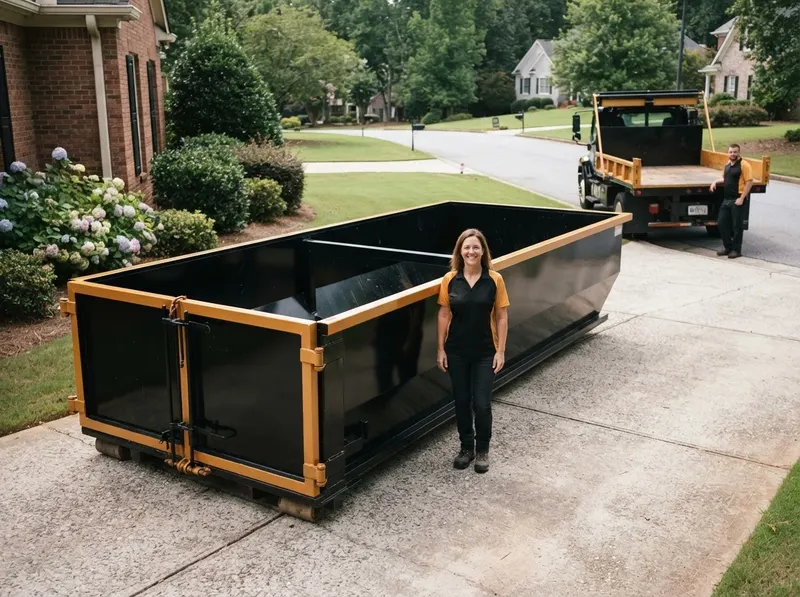
Managing masonry tear-outs and foundation pours requires strict containment protocols to prevent structural driveway failures and municipal environmental fines. Standard municipal waste systems cannot transport unyielding heavy aggregate without triggering dangerous axle weight violations. Under strict guidelines from the US EPA National Pollutant Discharge Elimination System, wet concrete wash water carries a corrosive pH level exceeding 12, making uncontrolled ground discharge on sites near the Atlanta BeltLine Eastside Trail an immediate regulatory violation. LoadCraft Debris Services delivers reinforced steel roll-offs fitted with watertight seams designed to capture corrosive slurry and dense rubble without leaking caustic fluids into neighborhood storm drains.
Demolition projects in historic zones like Inman Park, Cabbagetown, and Grant Park frequently face tight street parking profiles and fragile aggregate driveways. Delivering 10 tons of broken granite curbstones or century-old brick down narrow corridors near Oakland Cemetery demands exact logistical staging. Our drivers deploy heavy-gauge wood dunnage beneath every roller and support pad, preventing asphalt gouging and cracked concrete flatwork. Every load complies with Federal Motor Carrier Safety Administration gross vehicle weight ratings, keeping transport strictly within legal hauling limits over Interstate 85 and local thoroughfares.
Selecting container capacity for aggregate debris requires rigid adherence to volume-to-weight mathematics. Concrete weighs approximately 4,050 pounds per cubic yard, meaning a 10-yard container filled with cured footings quickly approaches 20 tons. Pouring contractors in Buckhead, Virginia-Highland, and Midtown renovating commercial properties along Peachtree Street or residential hardscapes near Piedmont Park select the 10-yard roll-off specifically to isolate dense rubble from lighter trade rubbish. For massive footprint demolitions near Centennial Olympic Park or expansive warehouse updates across the West End, 20-yard or 30-yard boxes accommodate bulk masonry, provided loading depths remain below container fill lines in accordance with OSHA 1926 construction safety standards.
Preventing operational halts requires precise job-site staging. A high-density container must sit on level, compacted gravel or structural concrete capable of bearing the loaded tandem-axle transport truck. The trade-off between compact 10-yard boxes and larger containers centers on debris density: oversized containers invite overfilling, which causes mechanical hoisting failure or emergency roadside re-stacking. LoadCraft Debris Services coordinates haul-offs directly with state-authorized recycling operations guided by the Georgia Environmental Protection Division and standards maintained by the National Ready Mixed Concrete Association. Materials proceed directly to aggregate recovery yards verified by the Construction & Demolition Recycling Association, keeping crushed stone diverted from regional municipal landfills according to Fulton County Government environmental protocols.
Every job gets a firm, written price after a free on-site visit.
For standards, safe disposal, and service guidance on DUMPSTER in Atlanta, GA, useful references include U.S. EPA, EPA, EPA, OSHA, Earth911, and Google Maps. General consumer and small-business resources are available from USA.gov, Better Business Bureau, FTC Consumer Advice, U.S. Small Business Administration, and Ready.gov.
Tell us about your heavy materials & concrete washout dumpsters job in Atlanta and we'll send a clear, written quote, usually the same day.
 LoadCraft Debris Services